 Sign In
Affect vs. Effect: How to Remember the Difference and Use Each Correctly
The difference between affect and effect matters more than most writers realize. The two words sound nearly the same in ordinary speech. They look almost the same on the page. But picking the wrong one can confuse your reader. The good news is that the core rule is simple. This guide explains the rule, the exceptions, and the pronunciation difference. It also covers the related pairs that trip people up: affected and effected, affects and effects, and affective and effective.
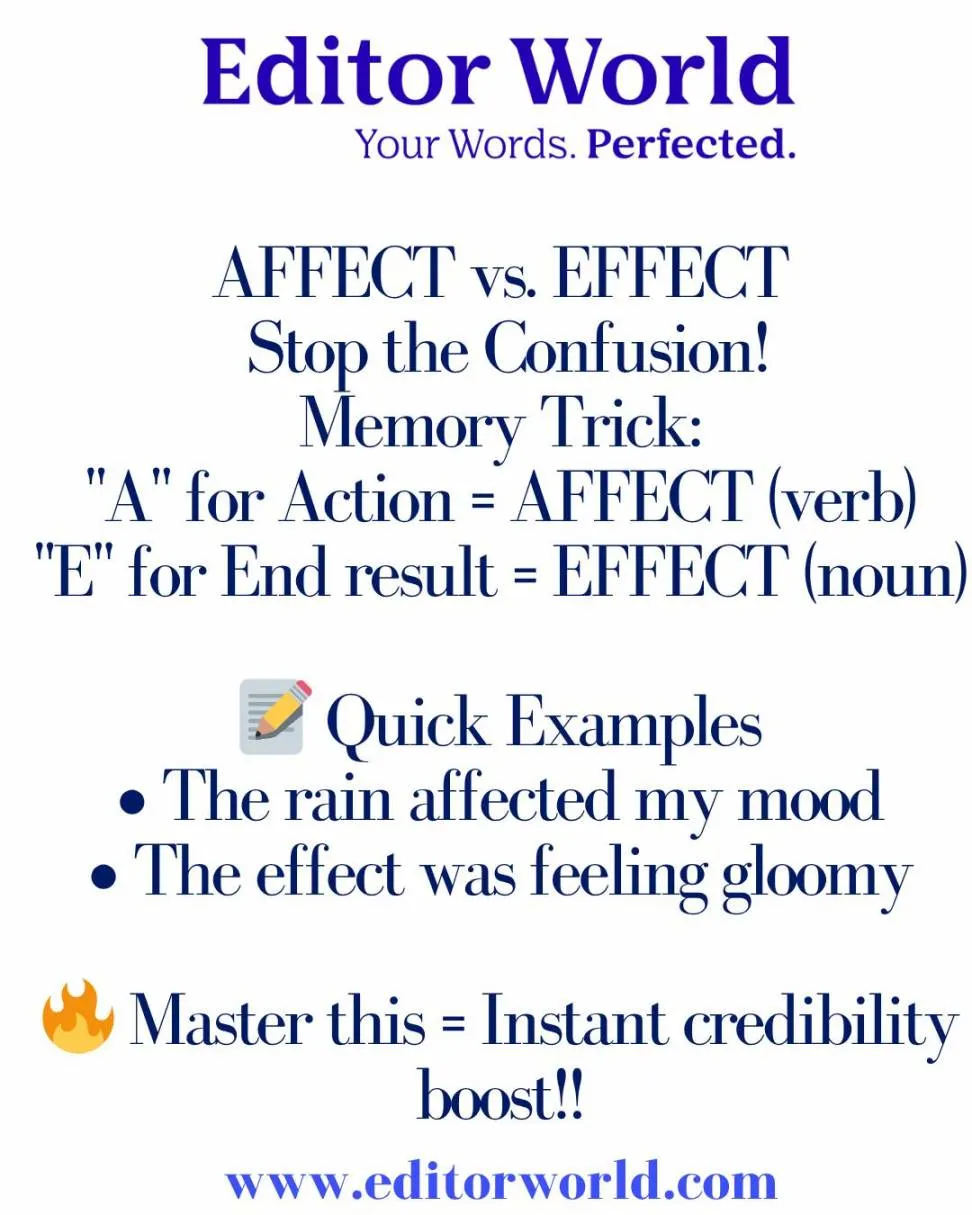
Quick Answer: Affect vs. Effect
Affect.
Usually a verb. It means "to have an impact on something." Example: "The weather affected her mood."
Effect.
Usually a noun. It means "a result or outcome." Example: "The weather had a strong effect on her mood."
The memory trick.
Affect is the Action. Effect is the End result. The "A" in affect stands for action (verb). The "E" in effect stands for end result (noun).
| Word | Usual role | Meaning | Substitution test | Example |
|---|---|---|---|---|
| affect | Verb | To influence or act on something | Swap in "influence" | The delay affected our schedule. |
| effect | Noun | A result or outcome | Swap in "result" | The delay had an effect on our schedule. |
| effect | Verb (less common) | To bring about or cause | Swap in "bring about" | The board hopes to effect real change. |
| affect | Noun (clinical) | Outward emotional expression | Swap in "emotional expression" | The patient presented with a flat affect. |
| affect | Verb (less common) | To pretend or put on | Swap in "feign" | He affected an air of indifference. |
Are Affect and Effect Homophones?
Not quite, and the difference is worth knowing. True homophones sound identical, like "brake" and "break" or "their" and "there." Affect and effect are near-homophones. In careful speech they carry different first vowels.
- affect (verb) is uh-FEKT, with a schwa in the first syllable
- effect (noun) is ih-FEKT, with a short "i" sound in the first syllable
- affect (clinical noun) is AF-fekt, with the stress moved to the first syllable
In relaxed, everyday speech, both unstressed first vowels reduce to the same neutral sound. That is why the two words are treated as homophones in casual conversation, and why so many people hear no difference at all. Dictionaries such as Merriam-Webster record the distinct pronunciations even though the contrast disappears in fast speech.
This matters for writers for one reason. You can't rely on your ear. Because the sounds collapse when you speak quickly, saying the sentence out loud won't tell you which spelling you need. You have to decide by grammar instead, which is what the next two sections cover.
When to Use Affect
Affect is almost always a verb. It means "to have an impact on" or "to cause a change in." If you can swap in the word "impact" or "influence" and the sentence still makes sense, affect is the right choice.
- The bad weather affected her commute.
- The new policy will affect every employee in the building.
- Lack of sleep can affect your emotional state and your focus.
- The findings affected the team's research direction.
- Loud noises can affect a child's concentration during testing.
In each example, affect is the verb. Something does something to something else. The action causes a change.
Affect as a Noun: The Clinical Use
Affect can also work as a noun, but only in a specific context. In psychology and clinical writing, "affect" refers to a person's outward emotional state. It describes how someone shows their feelings through facial expression, tone of voice, and body language. This use is rare outside of clinical settings.
- The patient presented with a flat affect.
- Her affect seemed appropriate to the situation.
- The therapist noted a marked change in his affect.
Note the pronunciation shift. The clinical noun is AF-fekt, with stress on the first syllable, not uh-FEKT. Affect in this sense is not the same as feelings or mood. It is the outward sign of an inner emotional state. If you're writing outside of clinical psychology, you'll almost never use affect as a noun.
Affect Meaning to Pretend or Put On
There's a third sense of affect that most guides skip. As a verb, affect can also mean "to pretend," "to feign," or "to adopt a manner that isn't natural." This use is uncommon but it appears in fiction, criticism, and formal prose.
- He affected an air of indifference during the interview.
- She affected a British accent for the role.
- The narrator affects a casual tone that hides real anxiety.
This is where the adjective "affected" comes from, meaning artificial or pretentious. An affected manner is a put-on manner. Effect never carries this meaning.
When to Use Effect
Effect is almost always a noun. It means "a result" or "an outcome." If you can swap in the word "result" and the sentence still makes sense, effect is the right choice.
- The new policy had a strong effect on employee morale.
- The side effects of the medication were mild.
- Climate change is having a clear effect on coastal cities.
- The special effects in the film were stunning.
- The teacher's praise had a positive effect on the student.
In each example, effect is a noun. It's the result, the outcome, the consequence of something that happened.
Effect as a Verb: To Bring About
Effect can also work as a verb. As a verb, it means "to bring about" or "to cause." This use is less common and shows up most often in formal writing about policy, business, and institutional reform.
- The new manager hopes to effect real change in the department.
- The committee's goal is to effect a smooth transition.
- The reforms were designed to effect a fairer system.
Notice the meaning. "Effect change" means to cause change to happen. "Affect change" would mean to act on change that already exists, which is rarely what a writer intends. This is a common error in business and policy writing.
Affected vs. Effected
The past-tense forms follow the same logic as the base words, but the error rate is higher because the two forms look even more alike.
- Affected is the past tense of the verb affect. It means influenced or acted on. "The drought affected crop yields."
- Effected is the past tense of the verb effect. It means brought about or accomplished. "The board effected a merger."
- Affected also works as an adjective meaning artificial or pretentious. "His affected accent fooled nobody."
The test is what the sentence is claiming. If the subject changed something that already existed, use affected. If the subject created something that did not exist before, use effected. "The policy effected employees" is wrong, because employees already existed. The policy influenced them, so it affected them.
Affects vs. Effects
The plural and third-person forms split the same way.
- Affects is usually the verb, third person singular. "Stress affects sleep quality."
- Effects is usually the plural noun. "The effects of stress build up over time."
- Effects can also be a verb in the formal sense. "The legislation effects sweeping reform."
If a word like "the," "these," or "several" sits in front of it, you almost certainly need effects. Articles and determiners come before nouns, not verbs. "The affects of the drug" is wrong. "The effects of the drug" is right.
Affective vs. Effective
These adjectives cause real trouble in academic writing. In psychology and education, both words are common and both are correct in their own contexts.
- Affective relates to emotion, feeling, or mood. It's a technical term in psychology and education research. "Affective disorders," "the affective domain of learning," "affective responses to the stimulus."
- Effective means producing the intended result, or working well. "An effective treatment," "an effective argument," "an effective teaching method."
Effective has a second sense too. It can mean "taking force from a given date." "The new rate is effective January 1." Affective never carries that meaning. If you mean something works, you want effective. Only reach for affective when you're specifically discussing emotion.
Where Affect and Effect Come From
The origins explain the rule better than any mnemonic, and they're worth two minutes if the distinction keeps slipping.
Both words trace back to the Latin verb facere, meaning "to do" or "to make." The prefixes are what split them apart.
- Affect comes from Latin afficere, built from ad- ("to, toward") plus facere. The literal sense is "to do something to." That's an action directed at a target, which is exactly what a transitive verb does.
- Effect comes from Latin efficere, built from ex- ("out") plus facere. The literal sense is "to work out" or "to accomplish." What gets worked out is a finished thing, which is why the English word settled into a noun meaning the result.
So the prefixes carry the whole distinction. Toward something is the action. Out of something is the product. Once you see that, the verb-noun split stops feeling arbitrary.
Affect vs. Effect: Correct and Incorrect Examples
Seeing the right and wrong versions in matched pairs makes the rule concrete.
| Correct | Incorrect | Why |
|---|---|---|
| The storm affected our weekend plans. | The storm effected our weekend plans. | Verb meaning "influenced," so affect. |
| The storm had a big effect on our weekend. | The storm had a big affect on our weekend. | Noun meaning "result," so effect. |
| Stress can affect your sleep. | Stress can effect your sleep. | Verb after "can," so affect. |
| One side effect of the medicine is drowsiness. | One side affect of the medicine is drowsiness. | Set phrase, always effect. |
| The CEO wants to effect real change. | The CEO wants to affect real change. | Verb meaning "bring about," so effect. |
| The therapist noted a flat affect. | The therapist noted a flat effect. | Clinical noun for emotional expression, so affect. |
| The effects of the drug were mild. | The affects of the drug were mild. | Plural noun after "the," so effects. |
| The treatment proved effective. | The treatment proved affective. | Means "it worked," so effective. |
How to Remember the Difference Between Affect and Effect
The easiest way to remember the difference between affect and effect is the A and E trick.
- Affect = Action (verb). The action affects something.
- Effect = End result (noun). The end result is the effect.
A second trick uses the word "impact." Most of the time, you can swap "impact" in for either word and see how it works.
- If "impact" works as a verb in your sentence, use affect. Example: "The news will impact her" becomes "The news will affect her."
- If "impact" works as a noun, use effect. Example: "The news had a big impact" becomes "The news had a big effect."
A third option is the article test. If the word follows "the," "an," "a," "this," or a number, you need a noun, which means effect in almost every case. Verbs don't take articles.
These tricks will get you the right word in nine cases out of ten. The tenth is one of the less common forms covered above.
Is It Affect On or Effect On?
This construction confuses people because the preposition "on" can follow either word, but only one version is usually correct.
- Have an effect on is correct. The noun takes the preposition. "The ruling had an effect on the market."
- Affect takes a direct object with no preposition. "The ruling affected the market." Never "affected on the market."
If "on" appears right after the word, you almost certainly need the noun effect. The one exception is when "on" belongs to a different part of the sentence, as in "the delay affected everyone on the team."
Common Phrases with Affect and Effect
Some set phrases use one word or the other in ways that don't follow the simple rule. These are worth memorizing outright.
- Side effect. Always effect. The result of a medicine, action, or process.
- Special effects. Always effect. The visual or sound effects in a film.
- Personal effects. Always effect. A person's belongings or possessions.
- In effect. Always effect. Means "currently in force" or "essentially."
- Take effect. Always effect. Means "to begin operating."
- Cause and effect. Always effect. The relationship between an action and its result.
- Placebo effect. Always effect. A response to treatment that is not caused by the treatment itself.
- Effect change. Always effect. The verb form, meaning "to cause change."
- To that effect. Always effect. Means "with that general meaning."
- Flat affect. Always affect. The clinical psychology term for reduced emotional expression.
- Affected manner. Always affect. Means artificial or put on.
Common Mistakes to Avoid
- Using "effect" as a verb when you mean "affect." "The weather effected my mood" is wrong. Use affected. The weather is acting on the mood.
- Using "affect" as a noun when you mean "effect." "The medicine had a strong affect" is wrong. Use effect. The medicine produced a result.
- Writing "affect change" when you mean "effect change." "Effect change" is correct when you mean to bring change about. This one shows up constantly in mission statements and cover letters.
- Writing "affective" when you mean "effective." An affective response is an emotional one. An effective response is one that works.
- Putting an article in front of "affects." "The affects of the policy" is wrong. Articles introduce nouns, so you need effects.
- Using "affect" instead of "effect" in set phrases. Personal effects, side effects, special effects, in effect, and take effect always use effect.
- Relying on autocorrect. Most word processors won't flag affect and effect errors, because both words are spelled correctly. The error is in word choice, not spelling.
Test Yourself
Pick the right word for each sentence, then check your answers below.
- The funding cuts will (affect / effect) every department.
- Researchers measured the (affect / effect) of sleep loss on memory.
- The new director wants to (affect / effect) lasting reform.
- The intervention proved highly (affective / effective).
- The clinician documented a blunted (affect / effect).
- The (affects / effects) of the policy were felt within weeks.
- Poor ventilation (affected / effected) the test results.
Answers.
1. affect (verb). 2. effect (noun). 3. effect (verb meaning "bring about"). 4. effective (it worked). 5. affect (clinical noun). 6. effects (plural noun after "the"). 7. affected (verb meaning "influenced").
More Commonly Confused Words
Affect and effect are one pair in a larger group of words that spell-checkers can't catch. For an overview of the whole set, see our roundup of nine confusing word pairs. For individual guides, see advice vs advise, principal vs principle, compliment vs complement, its vs it's, further vs farther, break vs brake, and diagnosis vs diagnoses.
If English isn't your first language, these pairs are harder than ordinary vocabulary, because many languages map both concepts onto a single word. Our English language editing service is built around exactly this kind of correction.
Frequently Asked Questions
What's the difference between affect and effect?
Affect is almost always a verb. It means "to have an impact on." Effect is almost always a noun. It means "a result." Example: The storm affected our plans (verb). The storm had a big effect on our plans (noun). The easy memory trick: A for action, E for end result.
Are affect and effect homophones?
Not exactly. They're near-homophones, not true homophones. In careful speech, the verb affect is uh-FEKT with a schwa, and the noun effect is ih-FEKT with a short "i" sound. In relaxed everyday speech both vowels reduce to the same neutral sound, so the words become indistinguishable. That's why you can't rely on your ear and have to decide by grammar instead.
Is affect ever used as a noun?
Yes, but rarely. In psychology and clinical writing, "affect" is a noun that refers to a person's outward emotional state, shown through facial expression, tone, and body language. The clinical noun is pronounced AF-fekt, with stress on the first syllable. Outside clinical writing, you'll almost never use affect as a noun.
Is effect ever used as a verb?
Yes. As a verb, effect means "to bring about" or "to cause." Example: "The new manager wants to effect real change." This use is less common and shows up most often in formal writing about policy or business reform. It's correct but easy to miss, because the noun form is so dominant.
Is it effect change or affect change?
It's "effect change." This is one of the most common errors in business writing. "Effect change" uses effect as a verb, meaning to cause change to happen. "Affect change" would mean to act on change that already exists, which usually isn't what you mean. When you want to bring change about, use effect.
Is it affected or effected?
Affected is the past tense of affect and means influenced. "The drought affected crop yields." Effected is the past tense of the verb effect and means brought about. "The board effected a merger." Ask whether the subject changed something that already existed, which needs affected, or created something new, which needs effected. Affected is also an adjective meaning artificial or pretentious.
What is the difference between affective and effective?
Affective relates to emotion, feeling, or mood. It's a technical term in psychology and education, as in "affective disorders" or "the affective domain." Effective means producing the intended result, as in "an effective treatment." Effective also means taking force from a date, as in "effective January 1." If you mean something works, you want effective.
Is it side effect or side affect?
It's "side effect." Always. A side effect is a result of a medicine, action, or process, so it's a noun. Side effect, special effects, personal effects, placebo effect, in effect, and take effect all use effect. Affect is never correct in these set phrases.
Is it affect on or effect on?
"Have an effect on" is the correct construction, because the noun takes the preposition. Affect takes a direct object with no preposition: "The ruling affected the market," never "affected on the market." If "on" comes right after the word, you almost always need the noun effect.
How do you remember the difference between affect and effect?
The simplest trick is the A and E rule. Affect starts with A for action, which signals the verb. Effect starts with E for end result, which signals the noun. A second method is to swap in the word "impact" and see whether it works as a verb or a noun. A third is the article test: anything following "the," "a," "an," or "this" has to be a noun, which means effect in almost every case.
Get Expert Help with Editing and Proofreading
Mastering commonly confused words like affect and effect is one part of producing polished writing. Word choice errors survive every spell-checker, because both spellings are valid. A trained editor reading for language rather than meaning catches them on every pass. Editor World connects you with native English editors from the United States, the United Kingdom, and Canada. You choose your own editor from verified profiles. Every document is reviewed by a real person, and no AI tools are used at any stage. Use our instant price calculator to see your exact cost. You can also browse our professional proofreading services, or choose a professional editor and request a free sample edit of your first 300 words. A certificate of editing is available as an optional add-on.
Content reviewed by the Editor World editorial team. Page last reviewed August 2026. Editor World, founded in 2010 by Patti Fisher, PhD, graduate of The Ohio State University, provides professional human-only editing and proofreading for students, academics, authors, and businesses worldwide. BBB A+ accredited since 2010 with 5.0/5 Google Reviews and 5.0/5 Facebook Reviews. 140 million+ words edited for over 8,000 clients in 65+ countries across 16 years in business. Multiple Gold and Bronze Stevie Award winner. Native English editors from the United States, the United Kingdom, and Canada. Less than 5% of applicants are accepted to the editor panel. Recommended by the Boston University Economics Department, University of San Diego, University of Michigan, UCLA, University of Missouri, and more. No AI tools are used at any stage.